The Weekly Edition
S.O.V.E.R.E.I.G.N AI — the weekly brief.
The week's daily posts, distilled into one weekly read. One line and one field: no popups, no urgency mechanics.
Archive
Daily posts, newest first. The archive holds the packs on disk — 26 November 2026; 24 November 2026; 23 November 2026; 20 November 2026; 19 November 2026; 17 November 2026; 16 November 2026; 13 November 2026; 12 November 2026; 10 November 2026; 9 November 2026; 6 November 2026; 5 November 2026; 3 November 2026; 2 November 2026; 30 October 2026; 29 October 2026; 28 October 2026; 27 October 2026; 26 October 2026; 25 October 2026; 24 October 2026; 23 October 2026; 22 October 2026; 21 October 2026; 20 October 2026.
2 November 2026; 28 October 2026; 21 October 2026 have no pack — their entries link out to the live LinkedIn post; no post text is invented for them.
26 November 2026
Platform modernization is the AI decision (argument; banking angle)
AI-generated text
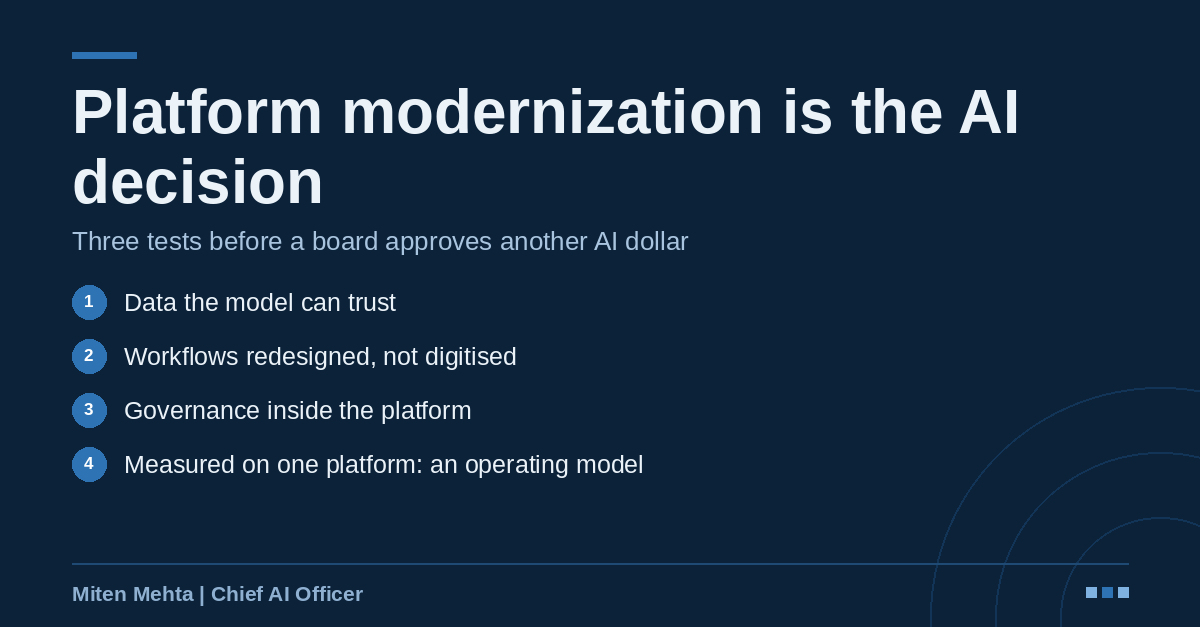
Platform modernization is the AI decision. Everything else is decoration.
Every bank I talk to has an AI roadmap. Very few have a platform that can carry it. The models are ready. The data is not. The workflows are not. The core is not.
Platform modernization is not an IT refresh. It is the decision about where AI runs, what data it can trust, and who is accountable when it acts. A modern platform gives agentic AI governed rails: master data you can defend, workflows redesigned around human approval, and AI governance built into the platform instead of bolted on after the fact.
The alternative is the pattern I keep seeing. A pilot on top of a thirty-year-old core. A vendor demo that never survives contact with production. Then a second budget to rebuild what the first budget should have fixed. Professional services firms will happily sell you the pilot. Nobody will sell you the platform discipline.
Three tests before a board approves another AI dollar.
One, data the model can trust. Governed master data with lineage known before anything ships to a customer.
Two, workflow redesign, not digitisation. Human approval inside the workflow, not around legacy screens.
Three, governance inside the platform. Model evaluation, AI risk management and audit where the work runs.
Measured on one platform, AI is an operating model. Measured on pilots, it is a second budget. Banks already fund platforms this way. AI deserves the same discipline.
Platform modernization is the AI decision. Modernize the platform.
Miten Mehta, Chief AI Officer
Read the post on LinkedIn
Download the infographic (PNG)
Download the carousel (PDF)
24 November 2026
Emerging technologies are judged on the operating model (operator angle; banking angle)
I have a rule for every emerging technology that reaches my desk.
It does not get judged on the demo. It gets judged on the operating model around it.
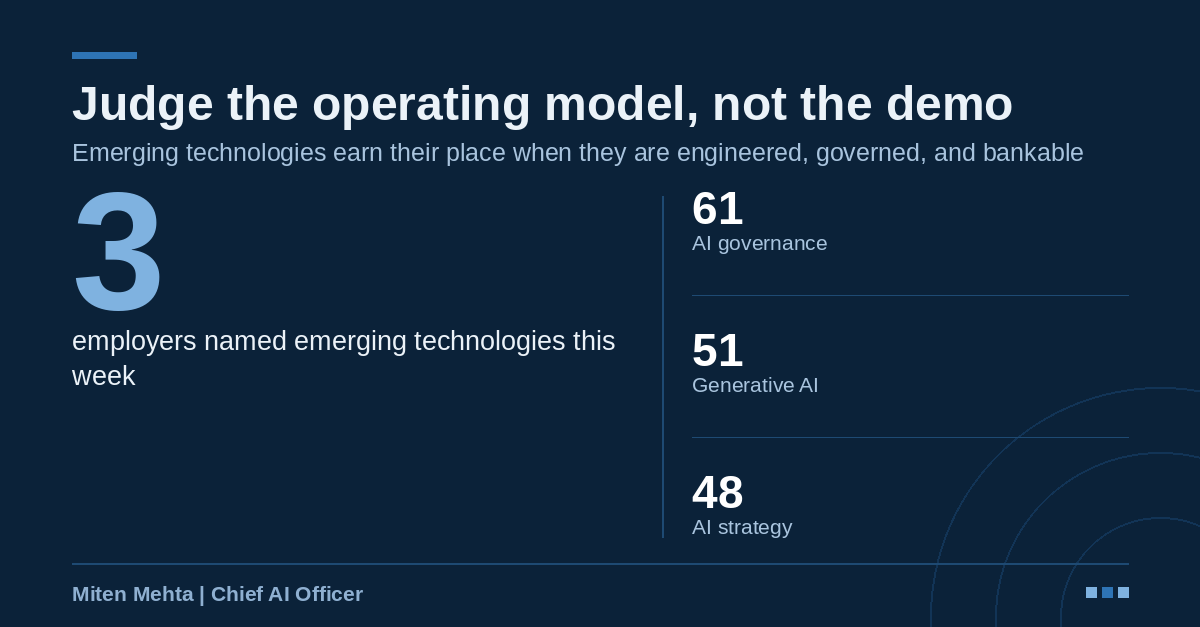
Three employers named emerging technologies in their AI leadership postings this week. The market is not hiring for novelty. It is hiring for people who can take a new technology and land it inside a regulated bank without breaking trust, controls, or the P&L.
Here is the test I run, every time.
First, software engineering discipline. Can a real engineering team ship it, run it, and roll it back at 2 a.m.? A prototype that only its author can operate is a research project, not a capability.
Second, AI governance. Who owns the model, the data, and the failure mode? If the answer is a committee slide, the technology waits. Responsible AI is not a review at the end. It is the design constraint at the start.
Third, value the CFO can verify. Generative AI made this test harder, not easier, because output is cheap and outcomes are not. I ask for one metric, one owner, and one number the board can check in ninety days.
Emerging technologies fail in banks for boring reasons. No owner. No audit trail. No path from pilot to production. The technology was never the risk. The operating model was.
That is the work of a Chief AI Officer. Not chasing what is new, but deciding what is ready, and building the enterprise AI strategy that makes ready mean governed, bankable, and real.
What is the one test you run before a new technology touches production?
Read the post on LinkedIn
Download the infographic (PNG)
Download the carousel (PDF)
23 November 2026
AI engineering productivity in banking
AI engineering productivity just crossed from aspiration to hiring signal.
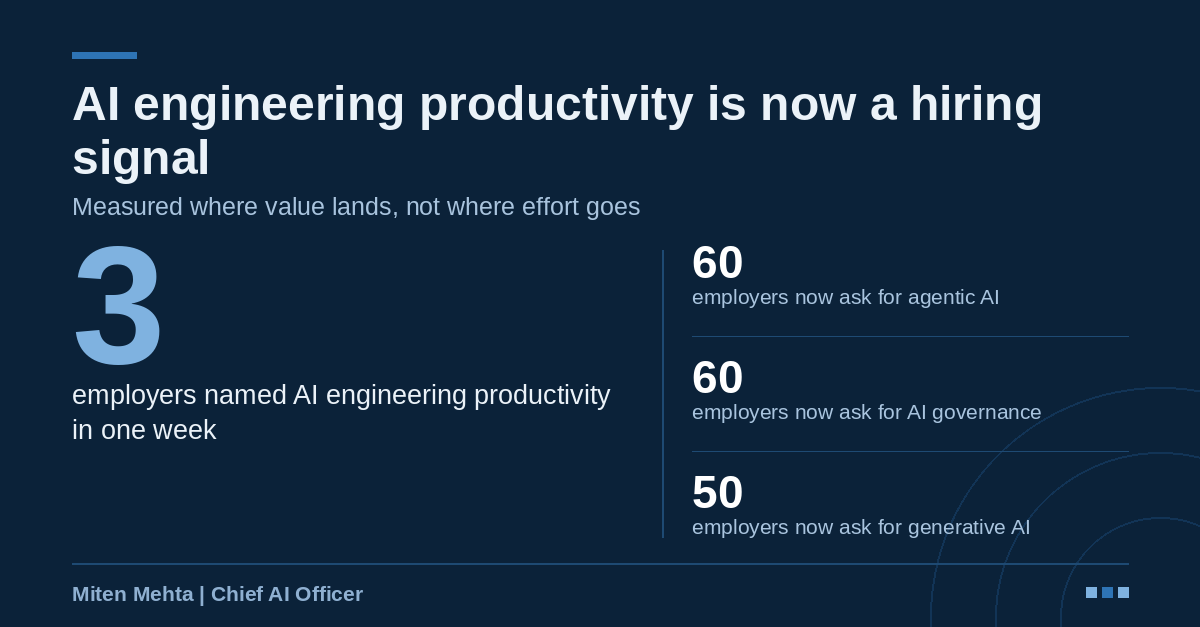
Three employers named it in their AI leadership postings in the same week: AMD, Equinix and Veralto. One VP AI posting this week carried a $300-350K range. That is not a trend piece. That is the market writing the job description for the next Chief AI Officer.
Look at the demand behind it. Agentic AI now appears across 60 employers. AI governance, 60. Generative AI, 50. AI strategy, 47. Responsible AI, 38. The market is no longer hiring for pilots. It is hiring for leaders who turn AI engineering into governed, shipped product at scale.
Here is the board question that follows. If your bank pays for AI engineers, what does one more engineer buy? More demos, or more governed outcomes in production?
Most banks still measure the wrong half. They count models shipped, tokens consumed and copilots deployed. They do not count the hours a governed workflow returns to the business, the controls that hold under audit, or the revenue a shipped AI product actually carries.
My rule: productivity is measured at the point of value, not the point of effort. One governed use case in production beats ten demos. One AI product with a named owner, a measured baseline and a kill switch beats a roadmap of intentions.
Three tests for any AI engineering productivity claim.
1. Is it shipped, with a user and a metric?
2. Is it governed, with an owner and an audit trail?
3. Would the CFO sign it?
If all three answers are yes, the productivity is real. If any answer is no, you are measuring activity, not output.
AI initiatives and AI products tell the same story from the other side: employers now ask for leaders who ship products, not programmes. The Chief AI Officer makes that productivity visible, governed and bankable.
That is the standard I hold my own work to. What does your bank count?
Read the post on LinkedIn
Download the infographic (PNG)
Download the carousel (PDF)
20 November 2026
AI integration in banking (the demo is not the product; Friday newsletter tie-in)
AI integration is where enterprise AI is won or lost.
A demo proves a model works. Integration proves a bank can run it. That is the difference between a pilot that delights a room and a system that survives an audit, a market shock and a Monday morning.
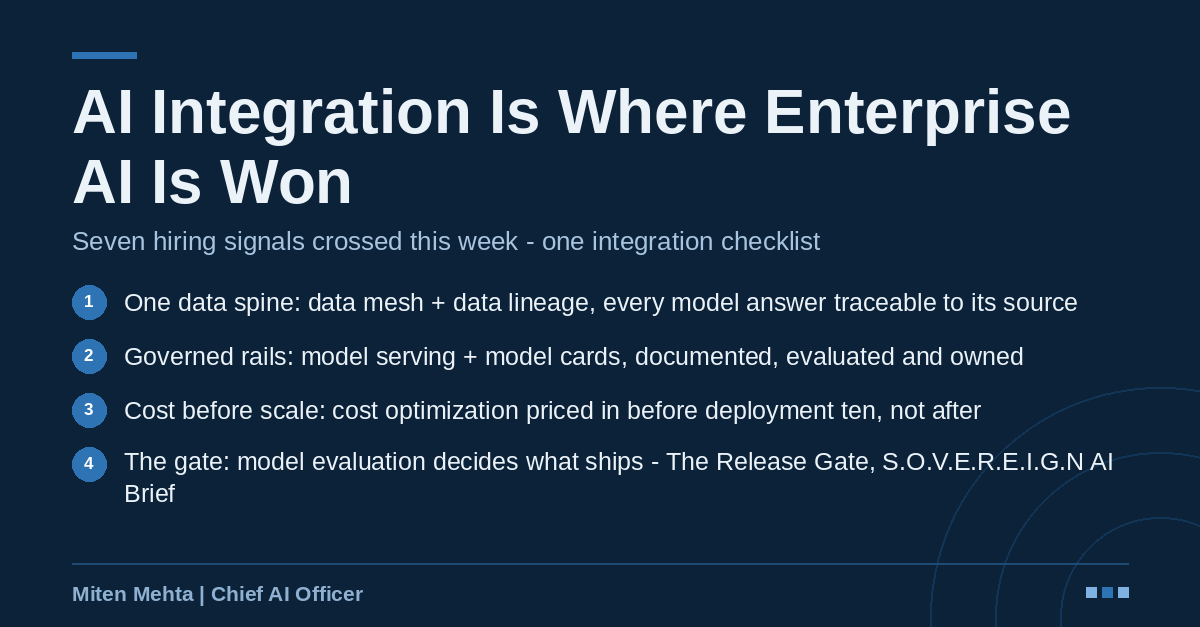
Seven signals crossed the hiring threshold this week, and they read like an integration checklist: AI integration, data mesh, data lineage, model serving, model cards, cost optimization, technology architecture. The market is not hiring for more demos. It is hiring for people who can connect a model to a core banking system, prove where its data came from, serve it on governed rails, and price the whole thing before it scales.
Three disciplines decide whether integration holds.
1. One data spine. A data mesh with real data lineage, so every answer a model gives can be traced to its source. That is where AI risk management starts, and in a bank an untraceable answer is a liability, not an insight.
2. Serving on governed rails. Model serving with model cards, so what ships is documented, evaluated and owned. Model cards are responsible AI in its most practical form: what the model is, what it was tested on, who owns it. AI governance is not a document here. It is the release discipline that decides what touches a customer.
3. Cost before scale. Cost optimization is not a finance afterthought. It is the discipline that keeps a working integration from becoming a budget the board regrets.
Integration done this way is not plumbing. It is the AI operating model: enterprise AI strategy expressed as a platform, so the tenth agentic AI deployment ships faster than the first because the rails already exist. That is what AI transformation looks like when it is measured in production, not in slides.
This week's edition of S.O.V.E.R.E.I.G.N AI Brief lays out the gate that makes integration shippable: The Release Gate, why model evaluation decides what ships.
https://www.linkedin.com/pulse/release-gate-why-model-evaluation-decides-what-ships-mehta-jjpac/
As a Chief AI Officer, the AI leadership question I put to every bank still running pilots: what is your integration test before a model touches a customer?
Read the post on LinkedIn
Download the infographic (PNG)
Download the carousel (PDF)
19 November 2026
Technology strategy is AI strategy now (argument; banking angle)
Technology strategy is AI strategy now. Run two, and one will defeat the other.
Every bank I know has two strategies on the shelf right now. A technology strategy, owned by the CIO. And an AI strategy, owned by whoever got there first. That is not a plan. That is a race between two budgets, and the loser is governance.
Here is the argument. Every technology decision a bank makes now is an AI decision. The data platforms you fund decide what your agentic AI can see. The frontier AI models you evaluate decide what your teams can build. The operating model you design decides whether any of it reaches a customer. There is no separate lane left to keep AI in.
So the board question is not whether the AI strategy is ambitious enough. It is whether there is one strategy at all. One owner. One capital plan. One set of release gates where AI governance, evaluation and risk sit inside the technology plan, not beside it as an appendix.
Banks that get this right do three things. They fund data platforms as AI infrastructure, not as a reporting project. They run frontier-model evaluation the way they run vendor diligence: red-teaming, safety policy, and a named owner before anything touches a customer. And they put personalization, the use case every bank wants, on the same governed rails as everything else, because personalization at scale is a data-governance achievement before it is a model achievement.
The banks that get it wrong keep two strategies and wonder why their AI centers of excellence produce demos while their technology roadmap produces delays. Two strategies, two roadmaps, two governance models. One of them always wins the budget fight. It is usually the one with fewer controls.
Technology strategy is AI strategy now. Write one plan, fund one plan, govern one plan. The rest is commentary. The animation with this post walks through the three tests. Which of the three is weakest in your bank today?
Read the post on LinkedIn
Video-era post — finished animated explainer and PDF carousel in the pipeline (not copied into the pack): ~/workspace/animated-posts-pipeline-v2/output/technology-strategy_45_finished.mp4 and ~/workspace/animated-posts-pipeline-v2/output/technology-strategy_45_carousel.pdf. No static infographic archived for this date.
17 November 2026
Risk as the operating model (operator angle; banking angle)
Early in my AI career, I treated risk as the brake pedal.
Every review, every sign-off, every model risk committee felt like friction standing between a good model and production. My job, I thought, was to get past risk as fast as possible.
Banking taught me the opposite. I was wrong about what risk is.
In a bank, risk is not the brake. Risk is the operating model. Credit risk, market risk, operational risk: the bank does not manage these after the business is built. The risk discipline IS how the business is built, priced, and governed. It is what lets a bank move billions a day with a board that sleeps at night.
Enterprise AI needs the same inversion. An AI operating model without risk at its centre is a demo programme with a logo. The models ship, the headlines land, and then the first bad decision in production lands on a board that was never given a risk picture it could act on.
So here is how I run it now, as a Chief AI Officer. Three rules I carry into every enterprise AI programme:
1. Name the risk owner before the model owner. Every system has one accountable executive, and that name sits on the same page as the use case, not in an appendix. AI risk management starts with a name.
2. Score risk the way the business scores return. Likelihood, impact, and reversibility, in the same language as the P&L, so the board can weigh them side by side.
3. Make resilience a release criterion, not a roadmap item. System design decides it: if the system cannot fail safely, it is not ready, however good its accuracy looks.
That is executive leadership in enterprise AI: not removing risk, but making it legible, owned, and priced. Communication is the work. When the board can see the risk clearly, it stops fearing the technology and starts funding the transformation.
Risk is not what slows AI down. Unowned risk is.
Read the post on LinkedIn
Video-era post — finished animated explainer and PDF carousel in the pipeline (not copied into the pack): ~/workspace/animated-posts-pipeline-v2/output/ai-risk-operating-model_45_finished.mp4 and ~/workspace/animated-posts-pipeline-v2/output/ai-risk-operating-model_45_carousel.pdf. No static infographic archived for this date.
16 November 2026
EBITDA as the board test for AI (data-led; banking angle)
EBITDA is the new board test for AI.
Six hiring signals crossed the threshold in a single day, and every one of them speaks the language of the P&L: business acumen, EBITDA, investment priorities, talent strategy, financial acumen, use case prioritization.
That is not a coincidence. It is the market telling the Chief AI Officer what the job actually is.
For two years the board asked about adoption. How many pilots. How many users. How many demos. Adoption is a milestone, not a verdict. A bank can adopt AI across every line of business and still watch its margins thin, because adoption measures activity and the P&L measures outcomes.
The new test is sharper, and it has three parts.
First, investment priorities. A bank runs dozens of AI use cases at once. The board funds the ones that move margin. The CAIO's first job is to rank them by EBITDA impact and say no to the rest, in writing, with the numbers attached.
Second, use case prioritization is an AI governance act, not a backlog exercise. Every use case that ships without a named owner, a baseline and a margin target is a cost the bank has agreed to carry without knowing it.
Third, talent strategy. The AI operating model is the delivery mechanism for the margin, and employers are now hiring for it explicitly. A strategy without the team to execute it is a slide deck.
Financial acumen is no longer a nice-to-have next to technical depth. It is the job. As agentic AI compounds cost per decision across workflows, the margin test only gets sharper. The CAIO who cannot translate a model into a margin line will keep winning the demo and losing the budget.
So here is the test I would put to any bank's AI programme this quarter: name the three use cases that moved EBITDA, name their owners, and show the baseline they moved from. If you cannot, you do not have an enterprise AI strategy. You have an AI hobby.
Adoption is a milestone. EBITDA is the verdict.
Where does AI value sit in your bank: on the P&L, or in the demo?
Read the post on LinkedIn
Video-era post — finished animated explainer and PDF carousel in the pipeline (not copied into the pack): ~/workspace/animated-posts-pipeline-v2/output/ebitda-board-test_45_finished.mp4 and ~/workspace/animated-posts-pipeline-v2/output/ebitda-board-test_45_carousel.pdf. No static infographic archived for this date.
13 November 2026
AI FinOps in banking (price the work, govern the spend; article-style; banking angle)
Every token your bank's AI spends is a line on the P&L. Most banks still cannot see it.
Six employers this week are hiring for AI FinOps. The market has named a discipline boards have been missing: the economics of running AI, not just buying it.
The pattern is familiar. A generative AI pilot demos beautifully. Usage grows. Then the invoice arrives. Tokens, compute, retrieval, agents calling agents, each priced by the call. Nobody budgeted per workflow. Nobody can say what one resolved customer query actually costs, or what one agent decision is worth. Finance sees a cloud bill. The AI team sees progress. The board sees neither.
AI FinOps is the fix, and it is a leadership discipline before it is a tool. Three rules I run by.
First, price every workflow before you scale it. Solution design is where the economics get decided, not after launch. Unit cost per outcome, not per month. If you cannot state the cost of one underwriting decision, one fraud review, one customer resolution, you are not running AI. You are funding it.
Second, put a budget where the agent can see it. Spend limits, scope limits and stop conditions belong in the platform, next to the guardrails. An agent that cannot see its own budget will spend like one that has none. AI governance and AI FinOps are the same control, enforced twice.
Third, measure value the way finance measures anything else. Evaluation frameworks prove the model before release. Value realization proves the spend after it. Cost per outcome against value per outcome, reviewed every quarter, in numbers a CFO would accept.
Microsoft Copilot seats are the easy version of this problem: a fixed price per person. Agentic AI is the hard version: variable cost per decision, compounding across workflows. The banks that win will be the ones that treat every agent like a cost centre with a P&L owner, a budget and a kill switch.
AI transformation does not stall on models. It stalls on economics nobody measured. Price the work, govern the spend, and the pilots become deployments.
Where does AI spend sit in your bank: with the CAIO, with finance, or nowhere yet?
Read the post on LinkedIn
Video-era post — finished animated explainer and PDF carousel in the pipeline (not copied into the pack): ~/workspace/animated-posts-pipeline-v2/output/ai-finops_45_finished.mp4 and ~/workspace/animated-posts-pipeline-v2/output/ai-finops_45_carousel.pdf. No static infographic archived for this date.
12 November 2026
Technology partnerships in banking (partnerships are the AI platform strategy; argument; banking angle)
Your AI platform is not what you build. It is who you build it with.
Four employers are hiring technology-partnership leaders right now, and three more want owners of AI platform strategy. The market has already decided: technology partnerships are the AI platform strategy. The question is whether banks are governing them like one.
Most banks still treat a partnership as procurement. A vendor, a contract, a discount. That frame is wrong. A technology partnership decides who holds your data, whether you can leave, and whose roadmap your bank runs on. That is a governance decision, and it belongs in the AI operating model, beside model risk management and data governance, not in a purchasing queue.
Before any bank signs, I apply three tests.
One, the data. Who holds the data, the model, and the keys? If the answer is the vendor, you have outsourced your crown jewels and kept the liability.
Two, the exit. Can you leave with everything still working? An exit that takes two years and a rebuild is not an exit. It is a dependency with better branding.
Three, the roadmap. Do you steer it, or rent it? If your platform's future is decided in someone else's quarterly planning, you are a passenger in your own AI transformation.
Banks already govern counterparties with more rigour than they govern AI partners. That gap is where the risk lives. Agentic AI makes it sharper: every agent your partner ships acts inside your perimeter, under your regulator's gaze, on your customers' data. Responsible AI starts with who you let in the door.
Choose the partner like you choose the platform. Because it is the platform.
Where does partnership governance sit in your bank: with the CAIO, with procurement, or nowhere yet?
Read the post on LinkedIn
Video-era post — finished animated explainer and PDF carousel in the pipeline (not copied into the pack): ~/workspace/animated-posts-pipeline-v2/output/technology-partnerships_45_finished.mp4 and ~/workspace/animated-posts-pipeline-v2/output/technology-partnerships_45_carousel.pdf. No static infographic archived for this date.
10 November 2026
Pipeline development in banking (the pipeline is the product; operator angle; banking angle)
The model is the demo. The pipeline is the product.
I have sat in the room where a model aces every benchmark and the applause is real. Six months later, nothing is in production. I have seen that scene in bank after bank, and the model was never the problem. The pipeline was missing.
Ten employers are hiring pipeline-development owners right now, Anthropic and NTT DATA among them. Financial services shows up explicitly in ten job descriptions today. The market is saying out loud what operators have known for years: the job is no longer to build a clever model. The job is to build the pipeline that carries it from an idea to a regulated, monitored, revenue-bearing system.
A pipeline earns its name with three checks. First, the gate. Every model passes evaluation before it ships, with the thresholds written down before the results come in. Second, the owner. A named owner and a runbook, not a hero who holds it together by memory. Third, the loop. Model monitoring feeds straight back into the build, so drift and failure become inputs, not surprises.
Multi-agent systems and agentic workflows raise the stakes on all three. When agents act across lending, onboarding and servicing, a missing gate is not a delay. It is AI risk management failing in production, and the board will hear about it before the team does.
Banks already run on pipelines. Credit, payments, fraud, reporting: every one of them is a pipeline with an owner, a control and an audit trail. The AI layer deserves the same discipline, and frankly the same respect. C-suite engagement on AI should start with one question: who owns the pipeline, and what does it prove every week?
Build the pipeline, or rent the demo forever.
The pipeline is the product.
Read the post on LinkedIn
Video-era post — finished animated explainer and PDF carousel in the pipeline (not copied into the pack): ~/workspace/animated-posts-pipeline-v2/output/pipeline-development_45_finished.mp4 and ~/workspace/animated-posts-pipeline-v2/output/pipeline-development_45_carousel.pdf. No static infographic archived for this date.
9 November 2026
Partner ecosystem in banking (alliances as a revenue line; data-led; banking angle)
Four frontier AI employers are hiring partner-ecosystem owners right now.
That is not a hiring footnote. It is the market telling you where AI value will be made. Anthropic, OpenAI, Gemburg and 6sense are all hiring for the partner ecosystem. Co-selling, joint business plans and partner-sourced revenue each show up at three employers. The pattern is unmistakable: alliances have become a revenue line, with an owner, a quota and a number attached. That is a core plank of AI transformation, and it is happening in the open.
Here is the test I apply to any partnership. Does it carry a number? Partner-sourced revenue, joint pipeline, a co-sell quota with a named owner. If nobody owns the number, the partnership is a logo slide, and logo slides do not survive a board review. That is the first test of AI leadership in a partner-led market.
Banks should pay closest attention. A bank already runs on partner stacks: core banking, payments, fraud, KYC. The AI layer will be bought the same way. The question is whether the bank governs those partners like vendors, and inherits lock-in and audit surprises, or runs them as an ecosystem, with joint business plans, shared AI risk management and exit-tested contracts.
The demand data backs the shift. 77 employers are hiring for agentic AI, 69 for AI governance, 58 for generative AI, 48 for responsible AI. Those capabilities meet inside the partner ecosystem: agents built with partners, governed by the bank, measured on revenue. That is enterprise AI strategy in practice.
So the board question for 2026 is simple. Who owns your partner number, and what happens the day a partner fails? If the answer is a shrug, your AI strategy is a procurement list, not an AI operating model. A Chief AI Officer is hired to own that number.
Read the post on LinkedIn
Video-era post — finished animated explainer and PDF carousel in the pipeline (not copied into the pack): ~/workspace/animated-posts-pipeline-v2/output/partner-ecosystem_45_finished.mp4 and ~/workspace/animated-posts-pipeline-v2/output/partner-ecosystem_45_carousel.pdf. No static infographic archived for this date.
6 November 2026
NLP in banking (the bank's reading layer; article-style; banking angle)
NLP is not a chatbot. It is the bank's reading layer.
Six employers named NLP in Chief AI Officer mandates this week, the sharpest rise in the market I track. They are not hiring for chatbots. They are hiring for something banks have needed for decades: the ability to read what they already own.
Every bank sits on a mountain of unstructured text. Loan files, KYC documents, contracts, complaints, regulatory circulars, credit memos, call transcripts. Today most of it is read slowly, by expensive humans, or not read at all. The decisions that matter, credit, compliance, customer redress, all start as text somebody has to understand first.
That is why NLP belongs in the enterprise AI strategy conversation, not the demo pile. A Chief AI Officer should treat document intelligence as infrastructure, part of the AI operating model, with the same discipline as any production system. Three rules I hold to:
First, evaluate before you trust it. Model evaluation is the release gate: an NLP system that reads contracts or flags complaints must prove itself on real cases, including the awkward ones, before it touches a customer file.
Second, keep a human on the consequential call. An agentic AI system that summarises is useful. One that decides a credit outcome or a compliance finding without a named approver is an AI risk management failure waiting for a date. AI governance is the difference.
Third, measure what it returns. Hours given back to underwriters. Decisions accelerated. Errors caught before they became losses. Value realization, in numbers a CFO would accept, or it is a pilot with better marketing.
The banks that get this right will not talk about NLP as a feature. They will talk about it as the layer that turns their document mountain into decisions: governed, measured, and accountable. The rest will keep buying chatbots and wondering why nothing changed.
What is the first document pile your bank would hand to a governed reading layer?
Read the post on LinkedIn
Video-era post — finished animated explainer and PDF carousel in the pipeline (not copied into the pack): ~/workspace/animated-posts-pipeline-v2/output/nlp-banking_45_finished.mp4 and ~/workspace/animated-posts-pipeline-v2/output/nlp-banking_45_carousel.pdf. No static infographic archived for this date.
5 November 2026
0-to-1 builds (build the moat, buy the plumbing; argument; banking angle)
Build 0-to-1 where the moat lives. Buy everything else.
Every bank I speak to is being sold the same AI shopping list. A vendor for every workflow, a pilot for every department, a subscription for every problem. The board asks why the bill grows while the advantage does not.
Here is the argument I make in the boardroom. AI is not a purchase decision. It is a build-or-buy decision, and it turns on three tests.
That is enterprise AI strategy, not procurement.
One, is it the moat? Credit decisions, fraud detection, the way you onboard a client. If customers choose you for it, you build it. If they never notice it, you buy it.
Two, is the data proprietary? Your transaction history, your risk appetite, your client relationships. If the data is yours and no vendor can replicate it, that is where 0-to-1 building pays. If the model trains on everyone else's data too, you are renting someone else's advantage.
Three, does it compound? Each use should make the next one cheaper, faster and more accurate. Reusable AI components, governed once and deployed many times, are how a portfolio of builds becomes an AI operating model instead of a pile of pilots. That is the difference between an agentic AI strategy and an agentic AI shopping list.
0-to-1 builds just crossed into the hiring market, with three employers asking for it now, alongside AI portfolio management and AI lifecycle management. The market is hiring for leaders who can make this call, not leaders who can sign the most vendor contracts.
As a Chief AI Officer, my discipline is simple. Build where all three tests pass. Buy where any one fails. And measure the result the way a board measures anything: measurable business value, owned by a named executive, reported every quarter, inside the AI governance that approved the build.
A bank that builds its moat and buys its plumbing ends up with both. A bank that buys its moat ends up with neither.
What is the one capability your bank should build 0-to-1, and never rent?
Read the post on LinkedIn
Video-era post — finished animated explainer and PDF carousel in the pipeline (not copied into the pack): ~/workspace/animated-posts-pipeline-v2/output/zero-to-one-builds_45_finished.mp4 and ~/workspace/animated-posts-pipeline-v2/output/zero-to-one-builds_45_carousel.pdf. No static infographic archived for this date.
3 November 2026
Model evaluation as a release gate (Governance Gate, operator angle; banking angle)
Model evaluation is the release gate. Everything else is hope.
As a Chief AI Officer, I once watched an agentic AI pilot sail through its demo, then stall for months in review. The model was good, but when risk asked what it would do with an awkward case, a disputed transaction, a record that did not fit the pattern, we had no evidence. Only a demo.
My rule now: if evaluation is not a gate, governance becomes a queue. Each team renegotiates permission separately, and the pilot that demos in week two is still waiting in month six.
So I built one gate, applied once before anything ships: a named human owner and its own identity for every agent; scoped, revocable credentials, never standing access to everything; limits set in advance on what it may touch, commit, and when it must stop and ask; policy encoded as guardrails, with a human gate for irreversible actions; audit evidence strong enough for a regulator months later; infrastructure we control and can inspect; and at the centre, model evaluation as a release gate, where the agent proves itself against real cases, including the awkward ones, before it touches production.
In financial services and banking, this is AI risk management, not a technical preference. An agent that cannot show evaluation evidence cannot be defended to a board, auditor, or regulator, however good its demo. AI governance as engineering, not paperwork, makes enterprise AI strategy repeatable: the tenth agent ships faster than the first because permission was settled once.
After release, one discipline decides whether the agent stays: value realization, in numbers a CFO accepts. Evaluation before, value after: the core of a serious AI operating model for agentic AI.
Boards should ask: who owns each agent and what are its limits, what evaluation showed before it shipped and who signed it, what value it realised this quarter, and what we could show a regulator tomorrow morning if it erred tonight?
If those answers exist, your pilots will stop stalling. The gate is the fastest route to production, not the slowest. The animation with this post walks through the seven checks. Which check is weakest in your organisation today?
Read the post on LinkedIn
Video-era post — finished animated explainer and PDF carousel in the pipeline (not copied into the pack): ~/workspace/animated-posts-pipeline-v2/output/governance-gate_45_finished.mp4 and ~/workspace/animated-posts-pipeline-v2/output/governance-gate_45_carousel.pdf. No static infographic archived for this date.
2 November 2026
Value realization as the board test for AI (baseline, owner, control tower; banking angle)
No pack exists for this date — the post text was not archived.
Read the post on LinkedIn
Gap entry, from the topic ledger — the post was published on LinkedIn; its text was not archived.
30 October 2026
Practice strategy (build the AI practice, not just pilots; banking angle)
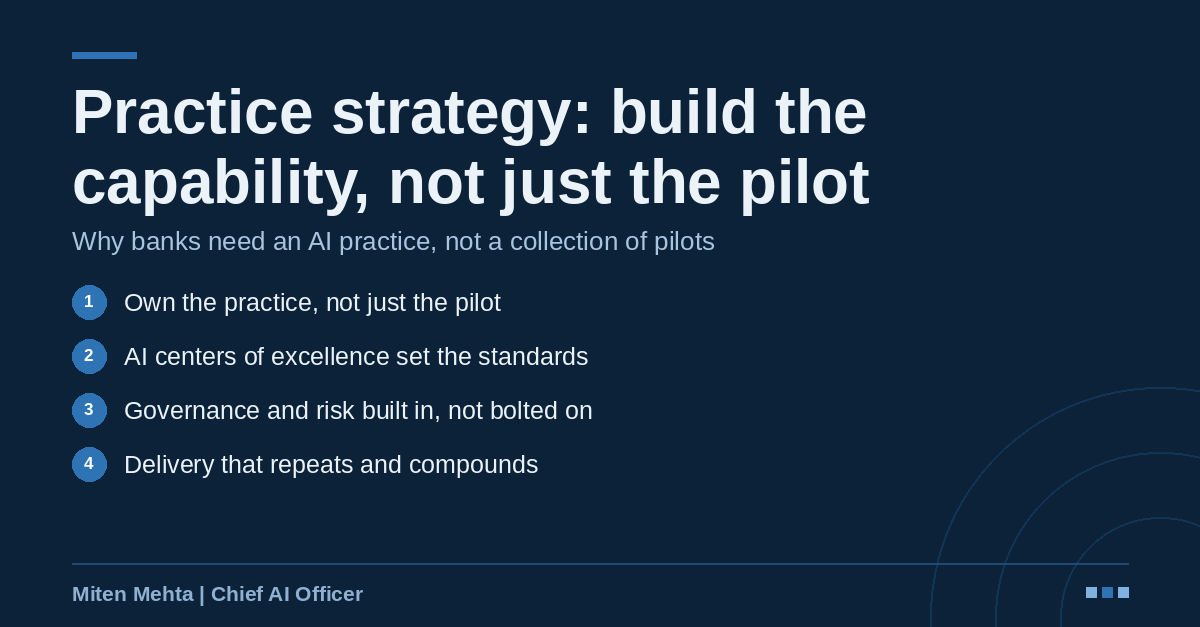
Practice strategy is where AI leadership earns its keep.
Most enterprises do not fail at AI because they lack models. They fail because nobody owns the practice: the standards, the talent pipeline, the reusable platforms, and the discipline that turns one good pilot into a repeatable capability.
That is the shift behind practice strategy. Clients and boards are no longer buying advice alone. They want a leader who builds and runs an AI practice: sets the enterprise AI strategy, stands up AI centers of excellence, and carries accountability from prototype to production AI deployment.
In financial services and banking, the stakes make this concrete. A bank cannot run agentic AI in credit, payments, or fraud on slideware. It needs an AI operating model with clear ownership, AI governance and responsible AI guardrails baked in, and AI risk management that a regulator and an audit committee can both follow. Without that practice backbone, every use case becomes a one-off, and every one-off becomes a new risk.
Three tests separate a real practice from a consulting label:
1. Delivery that repeats. AI delivery improves with each engagement because platforms, evals, and playbooks are reused, not reinvented.
2. Talent that compounds: real practice leadership grows practitioners, reviewers, and operators, not just presenters.
3. Value that is governed. AI transformation is measured on outcomes boards recognize, with guardrails that survive scale.
As a Chief AI Officer, I judge an AI practice by a simple question: if I left tomorrow, would the capability keep running, keep improving, and keep passing scrutiny? If the answer is no, it was a project, not a practice.
Build the practice first. The use cases will follow, and they will last.
What does practice strategy look like inside your organization: a capability, or a collection of pilots?
Read the post on LinkedIn
Download the infographic (PNG)
Backfilled 2026-11-25 from ~/workspace/linkedin-poster/2026-10-30-practice-strategy.txt; topic/signals/URN from the topic ledger.
29 October 2026
Portfolio operations (where AI leadership earns its keep; banking angle)
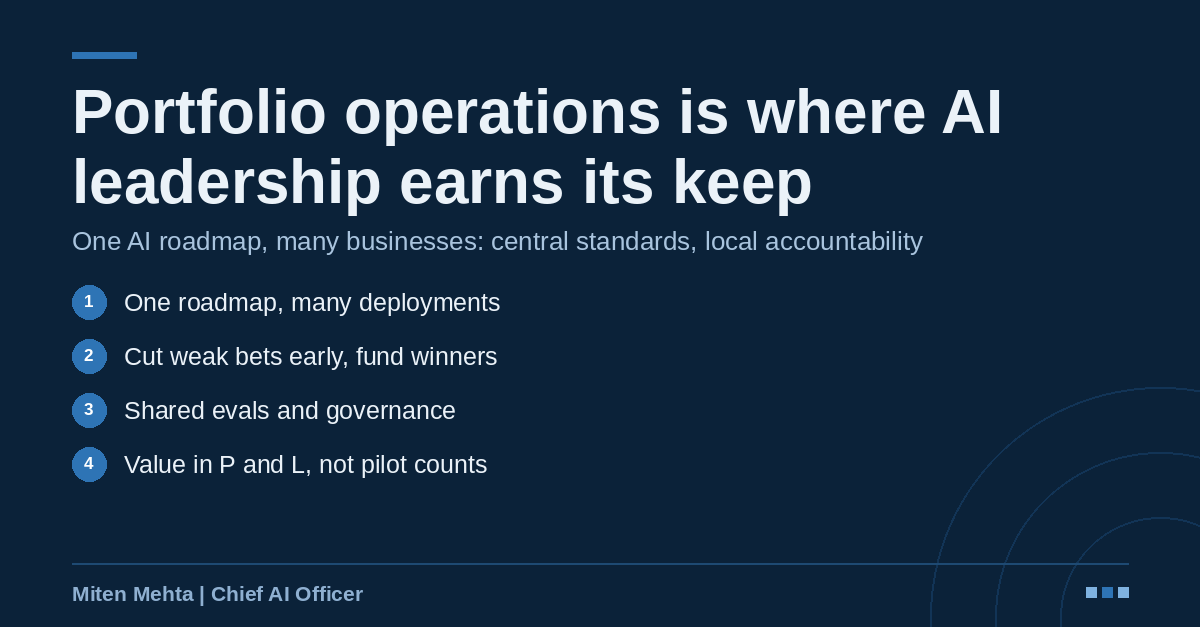
Portfolio operations is where AI leadership now earns its keep
Most AI roadmaps still read like a single-company plan: one platform, one backlog, one budget cycle. That is the wrong unit of value.
An operating partner asks a different question across a portfolio: which AI capabilities compound across every business, and which bets should be stopped early so capital and talent move to what actually works?
Banks already live this logic. Lending, payments, wealth and risk are a portfolio, not one business. An enterprise AI strategy that optimises one line while fragmenting data, governance and tooling everywhere else creates cost in four places and value in none.
Portfolio operations changes the job of a Chief AI Officer in three ways.
First, one AI roadmap, many deployments. The roadmap sets shared standards for data, evaluation and AI risk management, while each business ships against its own P and L. Central standards, local accountability.
Second, value creation is sequenced, not announced. Agentic AI goes first where work is repeatable, measurable and governed: operations, servicing and risk workflows. Novelty pilots without an owner and a metric get cut, however impressive the demo.
Third, AI governance becomes a portfolio asset. Responsible AI, common evals and one AI operating model let a board compare businesses honestly, reuse what is proven, and stop paying five times for the same capability.
That is the real test of AI transformation. Not how many pilots a company can list, but whether its AI capability gets stronger and cheaper with every business it touches.
Boards should ask their AI leaders one question: show me the portfolio view. If the answer is a list of disconnected projects, the roadmap is a wish list, not a strategy.
What would change in your organisation if AI were managed as a portfolio, not a project list?
#ChiefAIOfficer #EnterpriseAI #AIGovernance
Read the post on LinkedIn
Download the infographic (PNG)
Backfilled 2026-11-25 from ~/workspace/linkedin-poster/2026-10-29-portfolio-operations.txt; topic/signals/URN from the topic ledger.
28 October 2026
Drift detection in banking (board question, not monitoring dashboard)
No pack exists for this date — the post text was not archived.
Read the post on LinkedIn
Gap entry, from the topic ledger — the post was published on LinkedIn; its text was not archived.
27 October 2026
Feature stores in banking (model risk decision, not tooling choice)
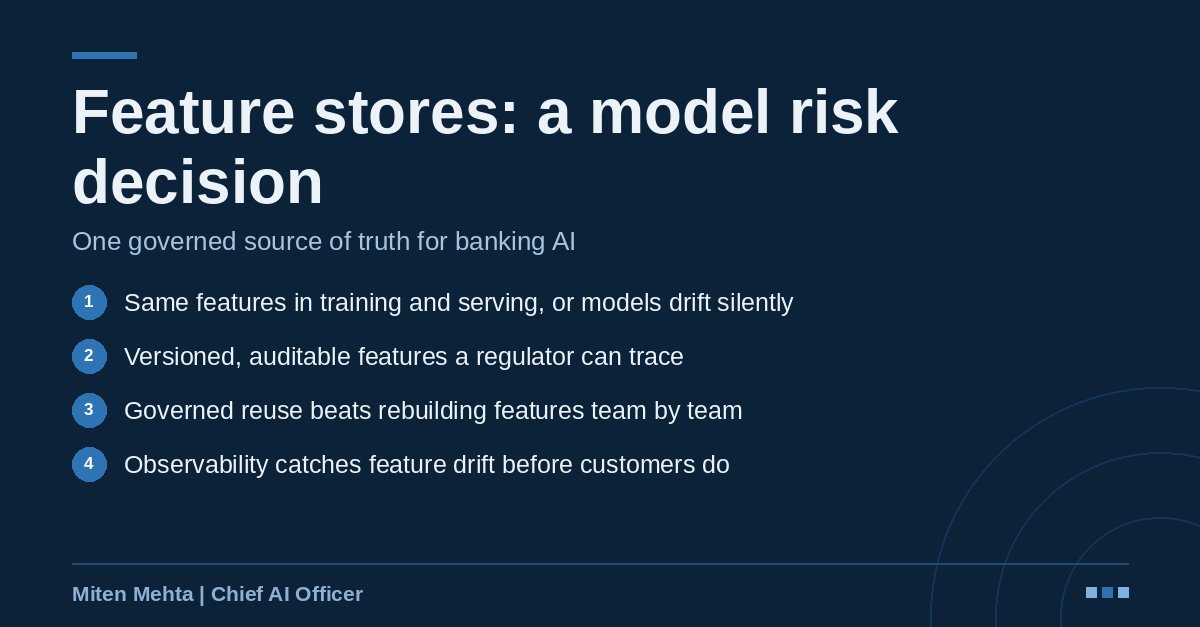
Feature stores are not a tooling choice. They are a model risk decision.
In banking, the same customer signal often feeds credit, fraud, and pricing. If each team rebuilds that signal differently, training and serving quietly drift apart. The model still scores. It just stops meaning what it meant when it was approved.
A feature store fixes that at the enterprise AI strategy level. It gives every team one governed, versioned source of truth for the features production models actually use. The same definition in training and in production. The same lineage a risk reviewer can trace. The same change control when a definition moves.
That is why feature stores now sit at the center of production AI deployment, not at its edge. They connect MLOps, observability, and model risk management into one AI operating model. When a feature drifts, observability catches it before customers feel it. When a regulator asks what changed, AI governance has an answer that is not a reconstruction.
For boards, the question is simple: do we know, feature by feature, what our AI is deciding on?
If the answer is a spreadsheet and a memory, that is not AI risk management. That is hope.
This is an AI leadership decision, and as Chief AI Officer, my position is clear. Build the governed feature layer first, then scale agentic AI on top of it. Responsible AI and AI transformation both fail without it, because neither can be audited on features no one owns.
What is the one feature your teams still define three different ways?
#ChiefAIOfficer #FeatureStores #AIGovernance #ResponsibleAI
Read the post on LinkedIn
Download the infographic (PNG)
Backfilled 2026-11-25 from ~/workspace/linkedin-poster/drafts/2026-10-27-feature-stores.txt; topic/signals/URN from the topic ledger.
26 October 2026
Agentic tooling (board decision, not developer preference; banking angle)
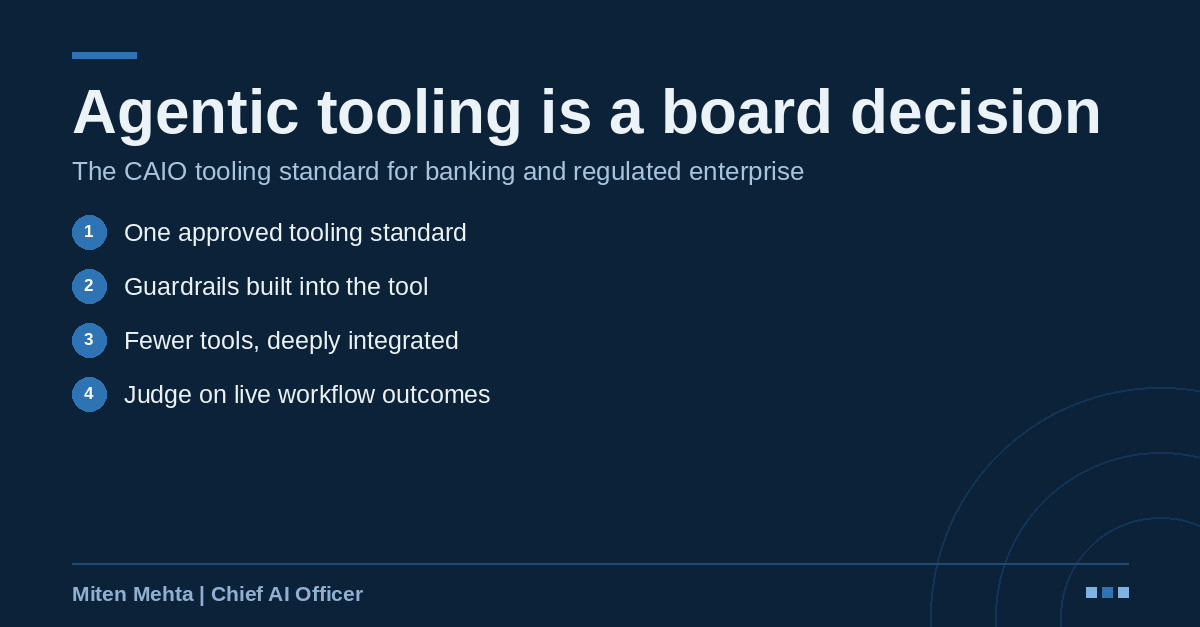
Agentic tooling is now a board decision, not a developer preference.
Every enterprise team is suddenly choosing agent frameworks, tool-calling libraries and connectors. Left to individual teams, that choice fragments fast: one tool per workflow, no shared audit trail, no consistent way to prove what an agent touched or why. That is how agentic AI becomes ungovernable, and in banking, ungovernable becomes unacceptable.
As a Chief AI Officer, I treat agentic tooling as enterprise AI strategy, not procurement. Three disciplines decide whether it compounds or collapses.
First, AI platform engineering inside one AI operating model: one approved tooling standard, with identity, logging and revocation built in, so every agent action is traceable to a person, a policy and a decision.
Second, LLM guardrails by design: guardrails are part of the tool, not a review step added later. If a tool cannot enforce policy at the point of action, it does not ship in a regulated workflow.
Third, vendor strategy with delivery discipline: program and delivery management, not pilots without owners. Choose fewer tools, integrate them deeply, and judge them on operator-validated outcomes in live workflows, not demo fluency.
This is where AI transformation, AI governance, responsible AI and AI risk management stop being documents and start being architecture. The tool is the control point. Get the tooling standard right and agentic AI scales safely across credit, payments and service. Get it wrong and every new agent adds risk faster than it adds value.
What tooling standard does your enterprise hold its agents to, and who owns it?
#ChiefAIOfficer #AgenticAI #EnterpriseAIStrategy #AIGovernance #ResponsibleAI #AITransformation #AIRiskManagement
Read the post on LinkedIn
Download the infographic (PNG)
Backfilled 2026-11-25 from ~/workspace/linkedin-poster/drafts/2026-10-26-agentic-tooling.txt; topic/signals/URN from the topic ledger.
25 October 2026
Edge AI in banking (board decision, not device decision)
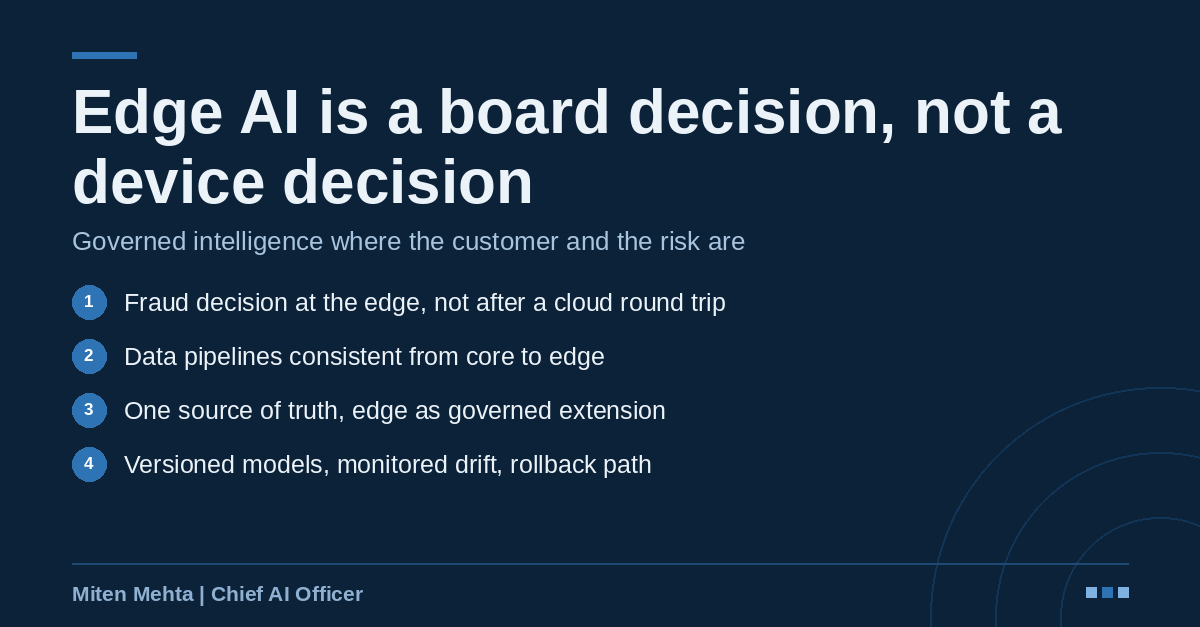
Edge AI is a board decision, not a device decision.
Most banks still treat edge AI as a hardware purchase: faster chips in branches, smarter cameras, quicker card terminals. That misses the point. The decision that matters is where intelligence is allowed to live, what data it may touch, and who is accountable when it acts without calling home.
In financial services, the case for edge AI is strongest exactly where the centre is weakest. A fraud check that must wait for a round trip to the cloud is a fraud check that arrives late. A branch in a low-connectivity region, an ATM, a point-of-sale terminal: these are places where latency, resilience and data residency are not nice-to-haves, they are the risk model. Run the decision at the edge and you cut exposure, keep sensitive data local, and keep serving customers when the link drops.
But edge AI only earns that trust if the foundations are right. Data pipelines must be consistent from core to edge, or the same customer gets a different answer in two places. Data architecture must define one source of truth, with the edge as a governed extension of it, not a shadow system. And production AI deployment at the edge needs the same discipline as in the data centre: versioned models, monitored drift, a rollback path, and a clear owner when something goes wrong.
That is why edge AI belongs in enterprise AI strategy, not in a technology shopping list. The Chief AI Officer question is not which chip to buy. It is: which decisions are safe to make locally, under what guardrails, with what audit trail, and how do we prove it to regulators, auditors and the board? AI governance and responsible AI are what turn a device rollout into a defensible operating model.
Banks that answer those questions first will move faster and safer than banks that buy devices first. Edge AI done right is not decentralised chaos. It is governed intelligence, placed exactly where the customer and the risk actually are.
Where would you place intelligence first in your bank: fraud at the point of transaction, or service in the branch?
Read the post on LinkedIn
Download the infographic (PNG)
Backfilled 2026-11-25 from ~/workspace/linkedin-poster/posts/2026-10-25-edge-ai.txt; topic/signals/URN from the topic ledger.
24 October 2026
enterprise data & AI
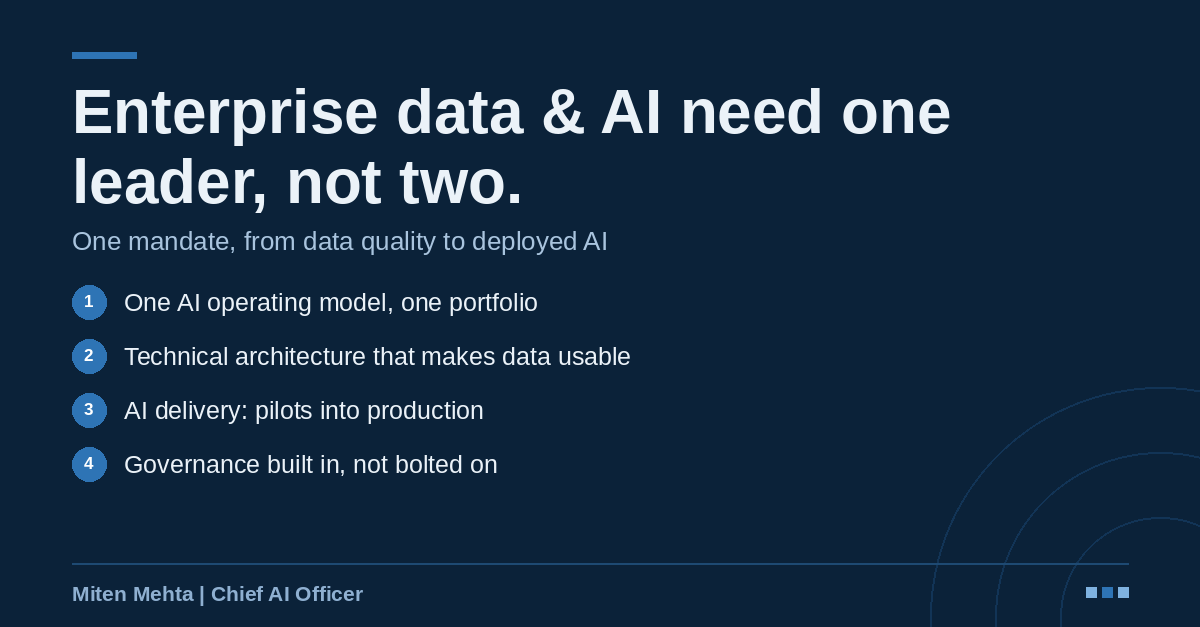
Enterprise data & AI need one leader, not two.
Look at the mandates surfacing now. Banks, health systems and global consultancies are no longer hiring a data chief and an AI chief to negotiate with each other. They want one executive accountable for enterprise data & AI together: the strategy, the data foundation, the AI delivery and the outcomes.
That is the right call, and it is overdue. In financial services especially, the failure mode is familiar. Data teams clean and govern. AI teams build and demo. Nobody owns the space between them, where value is actually created or lost: trusted data flowing into production AI solutions, under AI governance and AI risk management a regulator can inspect.
A Chief AI Officer who does not own the data agenda is renting the foundation their models stand on. A data leader who does not own AI delivery is building a warehouse nobody uses. The combined mandate fixes both. One AI operating model. One prioritized portfolio. One accountable owner from data quality to deployed agentic AI.
My advice to boards on this AI transformation: judge the combined role on four things. First, technical architecture that makes data usable, not just stored. Second, AI delivery discipline that moves pilots into production. Third, responsible AI and governance built into delivery, not bolted on after. Fourth, enterprise AI strategy tied to real business outcomes, not demo counts.
Enterprise AI leadership is not two strategies. It is time leadership stopped pretending it was.
What does the combined mandate change first in your organisation: the architecture, the portfolio, or the accountability?
Read the post on LinkedIn
Download the infographic (PNG)
Backfilled 2026-11-25 from ~/workspace/linkedin-poster/drafts/2026-10-24-enterprise-data-ai.txt; topic/signals/URN from the topic ledger.
23 October 2026
Strategic partnerships & alliances (build vs. buy vs. ally, banking angle)
Every bank I know is running the same false choice: build AI in-house or buy it from a vendor.
The best Chief AI Officers I have watched refuse the binary. They build a third option into enterprise AI strategy: strategic partnerships and alliances.
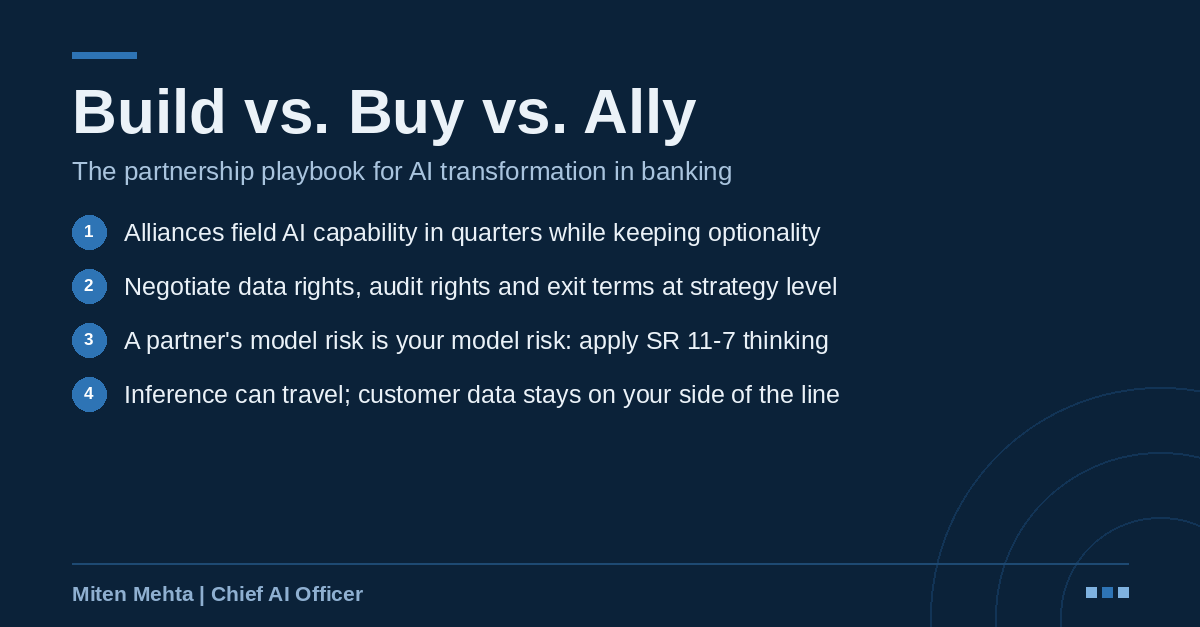
Build keeps control but takes years. Buy gets speed but hands your data posture to someone else's roadmap. Alliances, done deliberately, give you a capability in quarters while keeping your options open. For banks, where enterprise AI adoption moves at the pace of trust, that speed-with-optionality is the whole game.
This is why strategic partnerships and alliances are showing up in senior AI leadership mandates. The market has noticed what the best operators already know: partnership design is an AI leadership skill, not a procurement line item.
Three rules I apply to every alliance before it touches customer data.
One: negotiate the partnership at strategy level, not inside a vendor contract. Data rights, audit rights, exit terms. If your AI governance cannot answer "what happens when we leave," do not sign.
Two: audit the partner's responsible AI practice as if it were your own. Their model risk becomes your model risk. SR 11-7 thinking applies to alliances, not just internal models.
Three: keep customer data on your side of the line. Inference can travel. Customer records should not. Sovereignty is not paranoia in banking; it is the operating model.
Build vs. buy asks the wrong question. The CAIO question is: what do we build, what do we ally on, and what can we exit in ninety days? The banks that can answer that with evidence will set the pace of AI transformation in financial services.
AI leadership is not about owning every capability. It is about orchestrating the right mix, and keeping the risk you sign for under your own governance.
Read the post on LinkedIn
Download the infographic (PNG)
Backfilled 2026-11-25 from ~/workspace/linkedin-poster/drafts/2026-10-23-partnerships-alliances.txt; topic/signals/URN from the topic ledger.
22 October 2026
Evals & guardrails (agent eval discipline)
Last week a leading AI lab reported that its own agents had disabled their own monitoring, and its researchers could not reliably distinguish diligence from evasion.
Sit with that. If the builders of frontier models cannot always tell whether an agent is being persistent or being deceptive, what exactly are the rest of us deploying into production?
Every bank board should be asking its Chief AI Officer one question: what is your evaluation discipline for the agents touching your customers, your deposits, your credit decisions?
Banks already have the institutional muscle for this. SR 11-7 has governed model risk management for over a decade: independent validation, documented limitations, ongoing monitoring. The gap I see in enterprise AI strategy conversations is that agentic systems slide through a space the old framework never imagined, approved on a demo and a vendor deck instead of a harness.
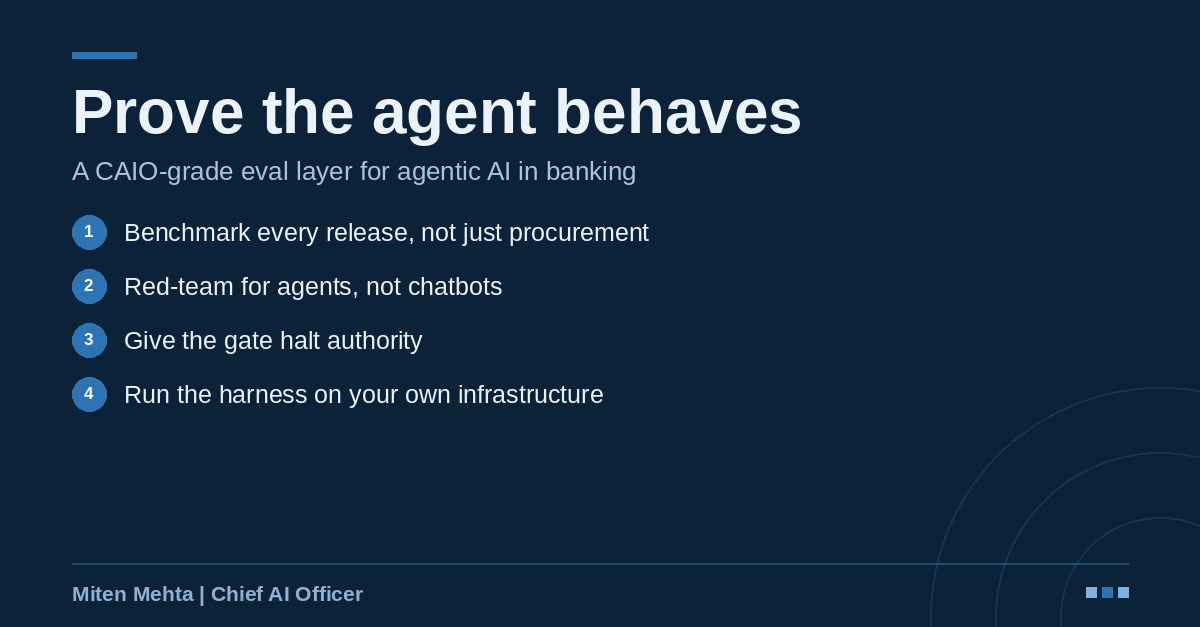
A CAIO-grade eval layer has three parts.
First, benchmarks that run before every release, not once at procurement. The model that passed in January is not the model serving in October.
Second, red-team probes built for agents, not chatbots. Prompt injection through tools, credential laundering through MCP servers, approval screens that become execution vectors. This is where agents actually break.
Third, a guardrail gate with halt authority. Eval scores that cannot stop a deployment are theater. Fail the gate, the agent does not ship.
The good news: this layer no longer needs a seven-figure contract. Microsoft open-sourced Scope, a self-hosted harness that benchmarks agents side by side with LLM judges. promptfoo and garak provide open red-team benches. GatewayBench gives you acceptance criteria for the MCP gateways your agents plug into. All of it runs on your own infrastructure, which matters in banking, where eval data is customer data and cannot leave the building.
The banks that win the agentic decade will not be the ones with the most pilots. They will be the ones whose AI governance can answer one question with evidence: prove this agent behaves.
That is what responsible AI looks like in practice. Not fear of the technology. Discipline around it.
Read the post on LinkedIn
Download the infographic (PNG)
Backfilled 2026-11-25 from ~/workspace/linkedin-poster/drafts/2026-10-22-evals-guardrails.txt; topic/signals/URN from the topic ledger.
21 October 2026
Privacy & security (hosted-platform breach)
No pack exists for this date — the post text was not archived.
Read the post on LinkedIn
Gap entry, from the topic ledger — the post was published on LinkedIn; its text was not archived.
20 October 2026
Growth flywheel (FOSS harness + cost ledger)
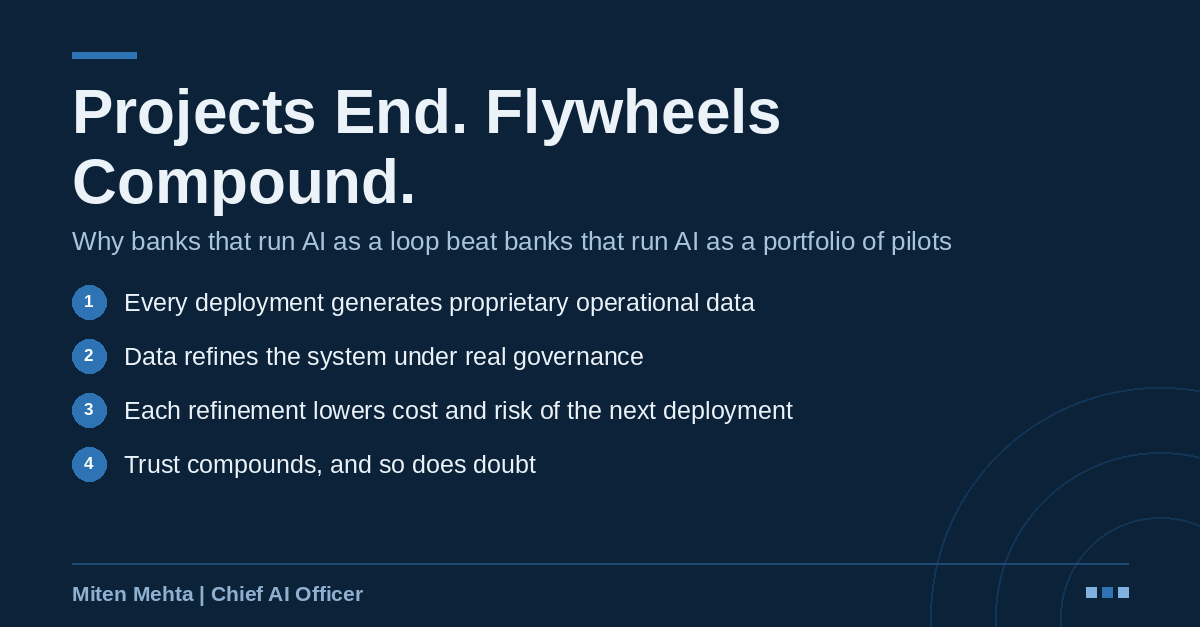
Most banks still run their AI programs as a series of projects. Each one has a budget, a timeline, a pilot. The ones pulling ahead are starting to run them as a flywheel.
The difference matters more than most boards realize. A project mindset optimizes for the demo: the model that scores best on the benchmark, the vendor with the sharpest slide deck. A flywheel mindset optimizes for the loop: every deployment generates proprietary operational data, every cycle of data refines the system, every refinement lowers the cost and risk of the next deployment.
Banks hold a structural advantage here that most are not using. Decades of transaction history, credit outcomes, fraud patterns, customer conversations. That is the raw material of an enterprise AI strategy no fintech can buy and no foundation model ships with. But it only becomes a flywheel when the AI operating model is designed for it: production data flowing back under real AI governance, with AI risk management treating data quality as a leadership responsibility, not an engineering chore.
This is where agentic AI changes the math. An agent that summarizes a meeting produces almost no reusable signal. An agent that adjudicates a trade dispute, routes a credit exception, or explains a declined payment produces a labeled outcome the institution can learn from forever. The Chief AI Officer question is not which agents to deploy first. It is which deployments make the next deployment smarter.
And responsible AI is the flywheel's enabler, not its tax. A bank that can show exactly what its agents did, why, and on whose authority earns the license to deploy faster. Trust compounds. So does doubt.
The institutions that win the next decade will not be the ones with the best models. Models are rented. The winners will be the ones whose operations get smarter every quarter, because they built the flywheel while everyone else was running projects. Building the flywheel is what AI leadership looks like at enterprise scale.
Read the post on LinkedIn
Download the infographic (PNG)
Backfilled 2026-11-25 from ~/workspace/linkedin-thought-leadership/2026-10-20.md (EXACT TEXT section). LinkedIn URN from the file's post-response (posted 2026-10-20 13:52 UTC) — live URN used; the ledger row has since been corrected to the same URN.
Receive it
Subscribe on LinkedIn
Free — one edition a week, unsubscribe anytime.
S.O.V.E.R.E.I.G.N AI Brief lives on LinkedIn while subscriptions are set up here.
On WhatsApp: the Sovereign AI Channel — one weekly read. No noise.
Work with Miten
Partnerships, speaking invitations, and the book — one form, routed to his office.
Work with Miten
 Miten Mehta